Author: admin

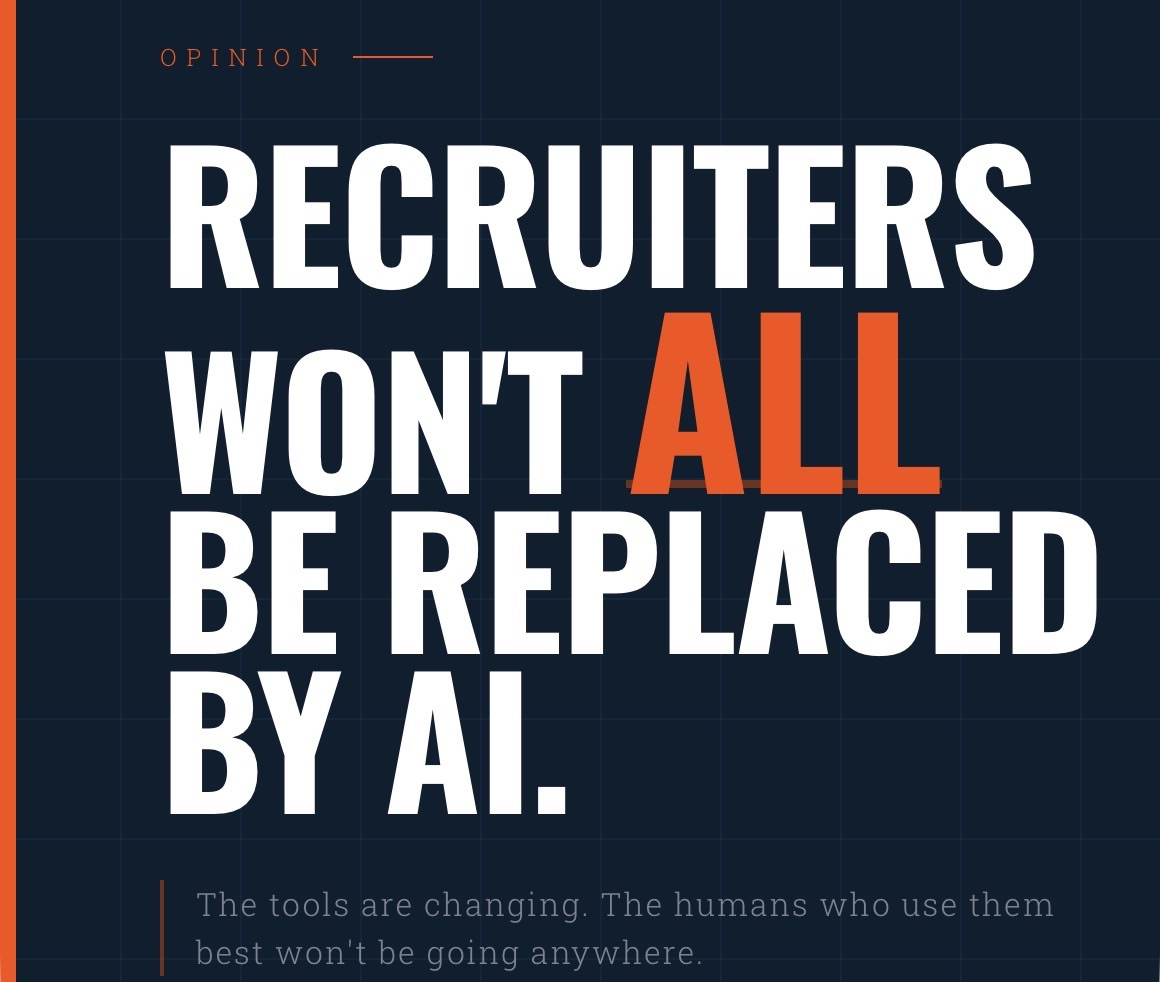
  • NO Recruiters won’t ALL be replaced by AI.

    NO Recruiters won’t ALL be replaced by AI.

    However some recruiters absolutely will be and if you think those are two different statements then read that again.

    Certainly in the UK, here’s what’s actually happening right now. 

    Companies are using AI to screen and rank CVs. 

    Recruiters are using AI to churn out job adverts that read like they were written by a drunk robot on a slow Tuesday afternoon and candidates are using AI to one click apply for job adverts they’ve never read, don’t want and in some cases probably couldn’t name if you asked them.

    The result? 

    Everyone’s bitching & wondering why candidate quality has collapsed and engagement has fallen though the floor.

    It hasn’t but the process has just become utterly broken from every angle at the same time,

    The recruiters who will get hurt aren’t the ones who ignore AI, they’re the ones sleep walking into it. Going all in on automation and integration without stopping to ask whether any of this is actually working or making the experience better for anyone involved.

    The thing nobody seems to want to say out loud is that a good CV and a good candidate are not the same thing, they never have been & never will be.

    Personality, attitude and enthusiasm…these are the things that actually determine whether someone is going to show up, fit in and stay. 

    No AI on the planet can (yet) sell those qualities for you, it can’t feel them. It can’t read a room. It can’t pick up on the tone of a call or sense that someone is genuinely excited about an opportunity as opposed to just saying the right words.

    That’s still a human job.

    What AI CAN do if you actually think about how you’re using it, is take some of the crappy and somewhat boring tasks away such as the admin, CV formatting and prospect researching (I won two clients today by using AI correctly so sorry about that if you’re the recruiter reading this… yes… you know who you are)

    However if you’re using AI to write your job adverts and then not reading them back, not asking whether a real human being would actually stop scrolling and read this, not checking whether the requirements make sense, whether the role sounds appealing or whether there’s a single compelling reason for the right candidate to care then you’re not using AI as a tool. 

    You’re just outsourcing your thinking and hoping for the best.

    Same goes for how we work with hiring managers as a huge part of our job is helping them understand the difference between a great looking CV and a cracking candidate. If we’re not having those conversations and instead we’re just pushing CV’s into Claude and letting AI make the shortlist then we’ve already made ourselves redundant but we just haven’t noticed yet.

    AI Used well with thought, with a human hands still on the wheel can genuinely make us better and faster recruiters.

    Used badly then it’s just a more efficient way to waste everyone’s time.

    The industry is changing and that’s fine right as change is mostly good.

    Just don’t stick your bonce in the sand, go full Ostrich and just expect is all to be fine.

    I write this as someone who loves tech, has been using AI since the early days but also spent a huge amount of time looking at the impact of prompts, learnt subtle key changes and always write freehand before then letting AI check my spelling, grammar and structure.

    Am I wrong ?
  • Why Your LinkedIn Posts Are Getting Ignored (And What To Actually Do About It)

    Let me save you some time here.

    If you’re a recruiter posting on LinkedIn and getting next to no engagement, wondering why you’re collecting three likes and a tumbleweed, it’s probably not your niche. It’s not your posting schedule.

    It’s not the hashtags you’ve been carefully adding to the bottom of every post like some sort of digital lucky charm.

    It’s simpler than that.

    You don’t understand what LinkedIn actually wants from you and until you get that part, nothing else really matters.

    LinkedIn is not a notice board. It’s not a job board. It’s a platform and like every platform ever built, its entire business model depends on one thing: keeping people on it for as long as possible. That’s it. That’s the whole game. The algorithm rewards content that makes someone stop mid scroll, actually read something and feel compelled to respond. It buries content that people glide past in two seconds, which if we’re being straight with each other, is most of what recruiters post.

    So you need to work with that, not against it.

    Write it yourself. No, actually write it.

    I can tell an AI written LinkedIn post within the first few lines. So can most people, even if they can’t explain exactly why. The structure is too tidy.

    Every paragraph lands the same way.

    The opinion is there but somehow has no edges to it and then there are the punctuation habits that crop up constantly in AI-written content that virtually no human being uses naturally when they’re just typing out their thoughts.

    AI is genuinely useful for plenty of things.

    Your LinkedIn content is not one of them BUT not if you actually want people to engage with it. People follow people. They want your take, your experience, your version of events, not a smoothed out, committee approved summary of what someone in your position might theoretically think. If your post reads like it could have been written by anyone, most people’s brains will quietly register that and move on.

    Write something with a bit of substance behind it. Have an opinion. Tell a story from something that actually happened. Be specific enough that someone reading it thinks “yeah, I’ve seen that too.” Even if people push back on what you’ve said, that’s not a bad thing.

    That’s exactly what the algorithm is looking for.

    Ask a question that deserves an answer.

    Finishing a post with “what do you think?” is the content equivalent of sending a blank text message. It gives people nothing to grab onto.

    If you want comments, ask something that requires the person reading it to actually reflect. Something with no clean, obvious answer. Something a hiring manager and a candidate might see completely differently. That friction is where conversations start and once the comments begin, the algorithm starts pushing your post in front of more people.

    That’s the mechanic.

    Use it.

    Go and talk to people on their posts BUT properly.

    Not just waiting around on your own content. Find the people in your space, hiring managers, HR leads, ops directors whoever is relevant to what you do and leave a comment that actually adds something.

    Not “great post, really valuable, thanks for sharing.” Everyone knows that’s nothing. It contributes nothing and frankly it makes you look like you’re just ticking a box.

    Ask them something.

    Offer a different angle.

    Give them a reason to write back to you, because when they do, their network sees your name too.

    You’re not just being polite, you’re getting in front of an audience you’d never reach otherwise and the platform rewards it because two people talking keeps both of them on LinkedIn longer. That’s the whole point.

    Use a real photo.

    Not a stock image. Not a Canva graphic with a quote on it and absolutely not something cooked up by an AI image generator that looks like a fever dream crossed with a corporate brochure.

    Find a real photograph of a real person doing something that directly connects to what your post is about. It’s the first thing anyone sees before they’ve read a single word and if it looks generic or fake, a large chunk of your potential audience won’t even get as far as your opening line.

    Do all of this consistently and your engagement will change. Not immediately, but it will change. You’ll be giving the platform what it’s designed to reward and it’ll respond accordingly.

    Don’t believe me?

    Try it properly for a month and see what comes back.

    Here’s my question to close on.

    Think about the last time you wrote a LinkedIn post and then sat there for a minute before hitting publish because you weren’t sure how it would land.

    What was it about? Because that hesitation is usually a sign you were about to say something worth reading.

  • Welcome to the Blog Nobody Asked For (But Probably Needs)

    Right then. Let’s get into it.

    I’ve been in recruitment long enough to remember when a CV was something a person actually sat down and wrote themselves. When a cover letter carried a bit of weight. When a hiring manager would just pick up the phone rather than hide behind a portal, a scoring matrix or some algorithm quietly binning good people before any human being has even glanced at their application.

    Things have changed. Some of it for the better. Quite a lot of it, if I’m honest…for the worse.

    This blog exists because I got fed up of nodding along to industry crap. Fed up of watching LinkedIn turn into a conveyor belt of AI-generated “thought leadership bollocks” from recruiters who’ve never actually had to work hard to place anyone. Fed up of reading candidate applications so slick and so empty they could have come from anyone and in most cases, they did.

    So here’s what this is. It’s my take based on years of actually doing this job. It’s honest, it’s sometimes blunt and if something I write makes you uncomfortable, there’s a good chance it’s because it hits a bit close to home.

    I’ll be covering what’s really happening in the job market right now.

    What candidates are getting wrong.

    What employers are getting wrong and what recruiters are getting wrong, because we’re absolutely not above criticism in this industry.

    I’ll also be talking about AI. Not because I think it’s all bad, it has its place but the way it’s being used in recruitment at the moment, across agencies, in house recruiters and by candidates, is often lazy, misleading and doing serious damage to people’s careers.

    Some of it you’ll agree with.

    Some of it you won’t.

    A few of you will probably roll your eyes and hit unfollow.

    That’s fine by me.

    If you want the straight version of what’s going on in this industry, stick around.

    If you’d rather not, no hard feelings.

    More soon.

    Scott